
A brief reflection on Thoughtworks Australia Data & AI mini-blogs.
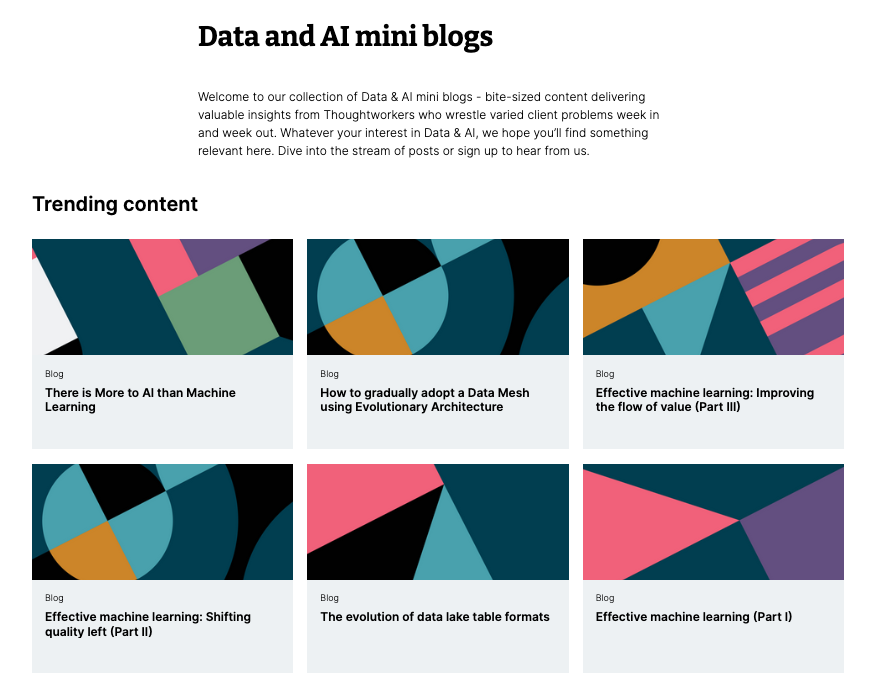
From May 2021, we set ourselves a target to publish a short blog on a different AI, ML or data topic every week. Here’s the pitch from the landing page:
Bite-sized content delivering valuable insights from Thoughtworkers who wrestle varied client problems week in and week out. Whatever your interest in Data & AI, we hope you’ll find something relevant here.
We deliberately kept this a local effort, until global review was introduced after 6 months, and publication halted. It would have been nice to keep going, but by then at least we had a great selection of articles.
The mini-blog model had many benefits:
- Capture key search terms for Thoughtworks – YMMV but I find articles like Weak Labelling ranked consistently highly for their terms
- Execute on content marketing strategy – providing a wider base for longer form insights and peak assets like Perspectives
- Spread our ideas and brand through clients and wider tech community – I’ve seen the excellent data planes framework organically appear in more than one client deck and was also amused that, from all the diagrams available for the modern data stack, ours was used to illustrate the stack through the Gervais principle
- Create a space for diverse perspectives on Data & AI – blogs that didn’t tackle tech, but instead slicing stories and team design were among our most popular
- Provide a quick reference for a topic – I frequently share our very first mini-blog on Active learning loops to illustrate how to bootstrap labelled data and make it go further, in more flexible ways
- Allow team members to share their expertise – including expertise on powerful techniques for the right problem, such as operations research or reinforcement learning
- Allow team members to develop their communication skills and consolidate on-the-job learning – many of the articles were written by first-time-bloggers; some went on to become authors!
- Allow team members to lift their profile with clients and the wider tech community – by referencing their content, in some cases already adopted by the audience (as above)
- Bring team members together in new collaborations – when reviewing each other’s work – a great way to share knowledge and a sense of team
And by deliberately keeping them small and time-boxed, we avoided spending too much effort on any one blog.
Most people miss this is a learning cycle
I’ll acknowledge this model has its limitations and is not appropriate for every context (it wasn’t even sustainable at Thoughtworks as the marketing context shifted), but you’ll note many of the benefits relate to social team learning, as we implemented a version of the Nonaka SECI cycle. It can work with an internal audience too, or even within the one team. Therefore I’d encourage anyone looking for these social team learning benefits to trial something like this model.
Here’s how we put it into practice:
- Aim for frequent, small sharing, and align your team and other supporting stakeholders towards this end-to-end cadence,
- Provide a standard format as a starting point. This clearly defines the sharing ask, and makes it tractable for the whole team. In our case this explicitly referred to the following elements:
- Ground the piece in a real example (at least in your mind),
- Describe an actual or potential approach,
- Include a diagram,
- Offer next steps
- Keep chasing people up to stay on publication cadence!
Linger for a moment to browse through the enduring collection of mini-blogs, and good luck implementing your own version of the learning cycle!