Author: safety
-

EV adventuring with resilience
Road trips are the most demanding EV scenario currently in Australia, especially to remote destinations. However, a little planning shows that they are still quite doable. Did the plans survive contact with reality? Mostly. In short, it was a pleasure to drive an EV long distances and the only inconvenience was faulty public charging infrastructure.…
-

R&D burn up
This article captures the key points of a conversation I have quite often with teams involved in exploratory work, and their stakeholders. Typical burn up We’re used to burn up charts looking like the examples in this description from Atlassian – a roughly horizontal scope line which we work towards with a roughly diagonal completed…
-
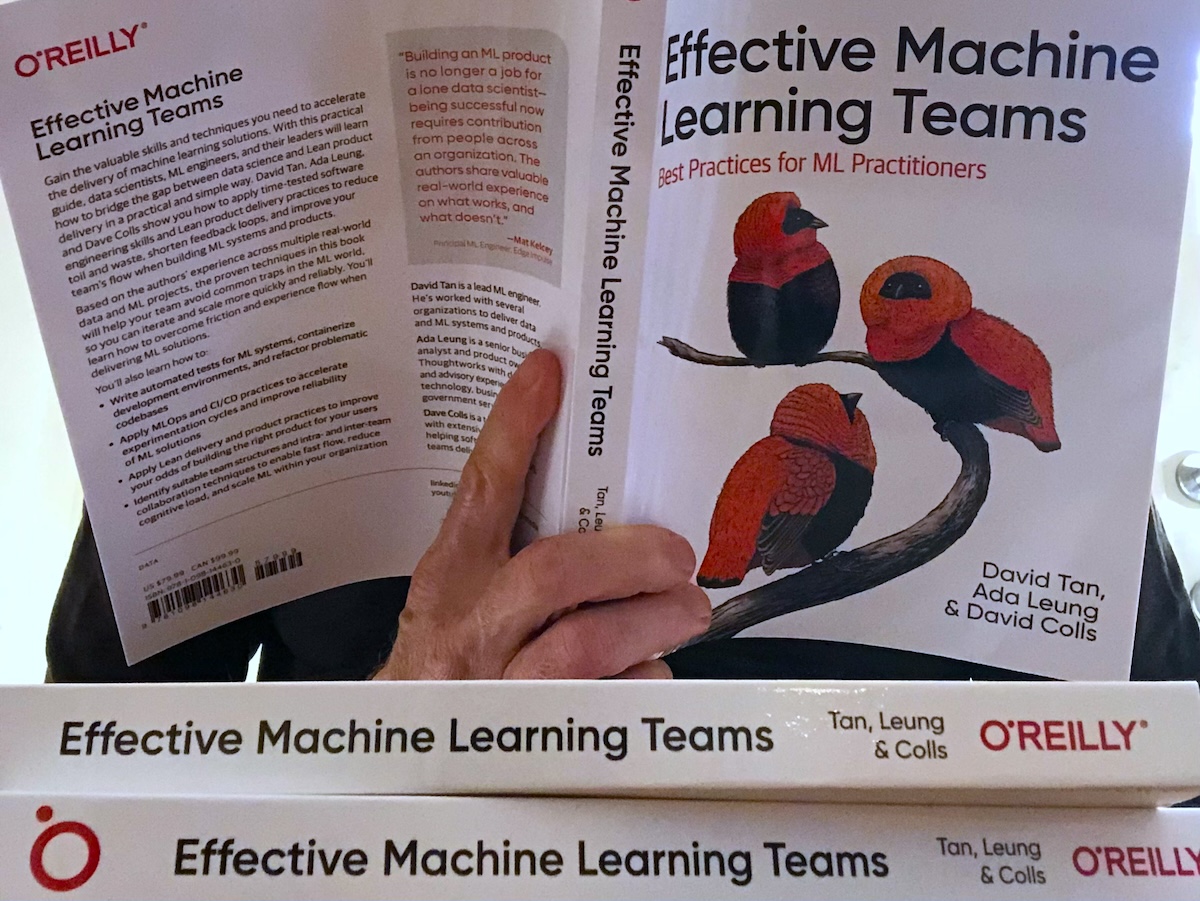
Effective Machine Learning Teams in print
My book Effective Machine Learning Teams is now in print! Building ML solutions requires multi-disciplinary collaboration. EMLT shows how to use design practices to identify the right products, how to apply good data science and software engineering practices to build products right, and how to structure ML teams and organisations so that they are right…
-

EV adventuring
Electric Vehicles (EVs) are great for weekend adventures and more. In Australia in 2024, it still requires a little extra planning, but many adventures are achievable with that little extra, and as infrastructure continues to improve, there will be ever less transport planning for ever more adventuring! For the time being, I’ll run you through…
-

Ten years of the safetydave.net blog
This blog recently turned 10! Let’s have a brief indulgent look at the highlights. Origins Though the safetydave.net domain has a longer history (and the “Safety Dave” nickname a longer history before that), I’d been reluctant to blog about work-related topics prior to joining Thoughtworks, probably because: After a couple of years in enterprise consulting,…
-

Effective Machine Learning Teams
I’m very excited to be writing a book with my colleagues David Tan and Ada Leung. The topic and title Effective Machine Learning Teams was born from our combined work on team technical and delivery practices, and wider organisational patterns, applied to developing machine learning applications. The book has two landing pages where you can…
-

Getting serious about testing AI
I was delighted to contribute to a Thoughtworks’ insights article on AI testing in response to Forrester’s recent report It’s Time To Get Really Serious About Testing Your AI. The report rightly raises the importance of testing in AI systems and highlighted Thoughtworks’ Continuous Delivery for Machine Learning (CD4ML) approach. The response also discusses other…
-

7 wastes of data production – when pipelines become sewers
I recently had the chance to present an updated version of my 7 wastes of data production talk at DataEngBytes Melbourne 2023. I think the talk was stronger this time around and I really appreciated all the great feedback from the audience. Check out the video below and the slides. Thanks to Peter Hanssens and…
-

Privacy puzzles
I contributed a database reconstruction attack demonstration to the book Practical Data Privacy by my colleague Katharine Jarmul. While we might think anonymous summary data is safe to share, this attack demonstrates it’s possible to dramatically reduce the search space for re-identification, in this case from half a trillion quadrillion possibilities to just one! My…
-

A gentle introduction to embeddings at the inaugural GenAI Network Melbourne meetup
I was thrilled to help kick-off the GenAI Network Melbourne meetup at their first meeting recently. I presented a talk titled Semantic hide and seek – a gentle introduction to embeddings, based on my experiments with Semantle, other representation learning, and some discussion of what it means to use Generative AI in developing new products…